The Grand Théâtre de Bordeaux Explained: History, Architecture and Cultural Significance
Standing in Place de la Comédie, the Grand Théâtre does not merely occupy space — it commands it.
At first glance, it appears almost impossibly symmetrical. Twelve Corinthian columns rise in perfect alignment. Above them, statues gaze outward, unmoving and assured. The building feels less like a theatre and more like a declaration.
To understand Bordeaux fully, you must understand this building.
The Grand Théâtre is not simply a venue for opera and ballet. It represents the moment Bordeaux transformed itself from a prosperous port city into an architectural statement. Its construction in the 18th century marked a turning point in how the city saw itself — refined, powerful, culturally ambitious.
If you explore Bordeaux on foot before stepping inside, the context becomes clearer. Seeing how the façades along Place de la Bourse align with the theatre’s classical symmetry reveals the city’s broader design philosophy. A structured Bordeaux Free Walking Tour connects these architectural decisions, showing how urban planning and cultural ambition evolved together.
Now let’s go deeper.
To see how the Grand Théâtre aligns with the city’s broader visual language, explore our guide to Place de la Bourse in Bordeaux, where classical symmetry and urban planning come together in one of the city’s most iconic ensembles.
The 18th Century: Bordeaux’s Architectural Transformation
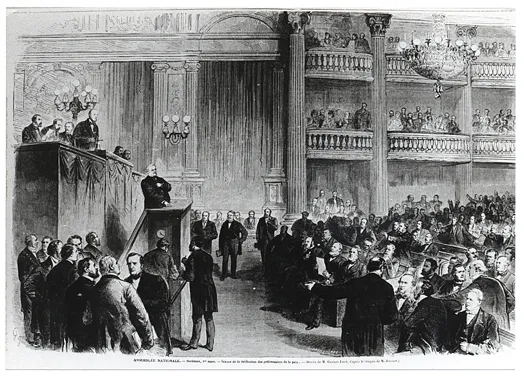
In the 1700s, Bordeaux was one of France’s wealthiest ports. Trade — including wine, colonial goods and maritime commerce — brought immense prosperity. With wealth came ambition.
The city embarked on a coordinated architectural programme designed to reshape its medieval layout into something orderly and monumental.
The Grand Théâtre, completed in 1780 and designed by architect Victor Louis, became one of the centrepieces of that transformation.
Its purpose was twofold:
- To provide a cultural venue worthy of Bordeaux’s status
- To assert the city’s intellectual and artistic sophistication
This was not accidental decoration. It was civic messaging in stone.
Architecture: A Study in Neoclassical Precision
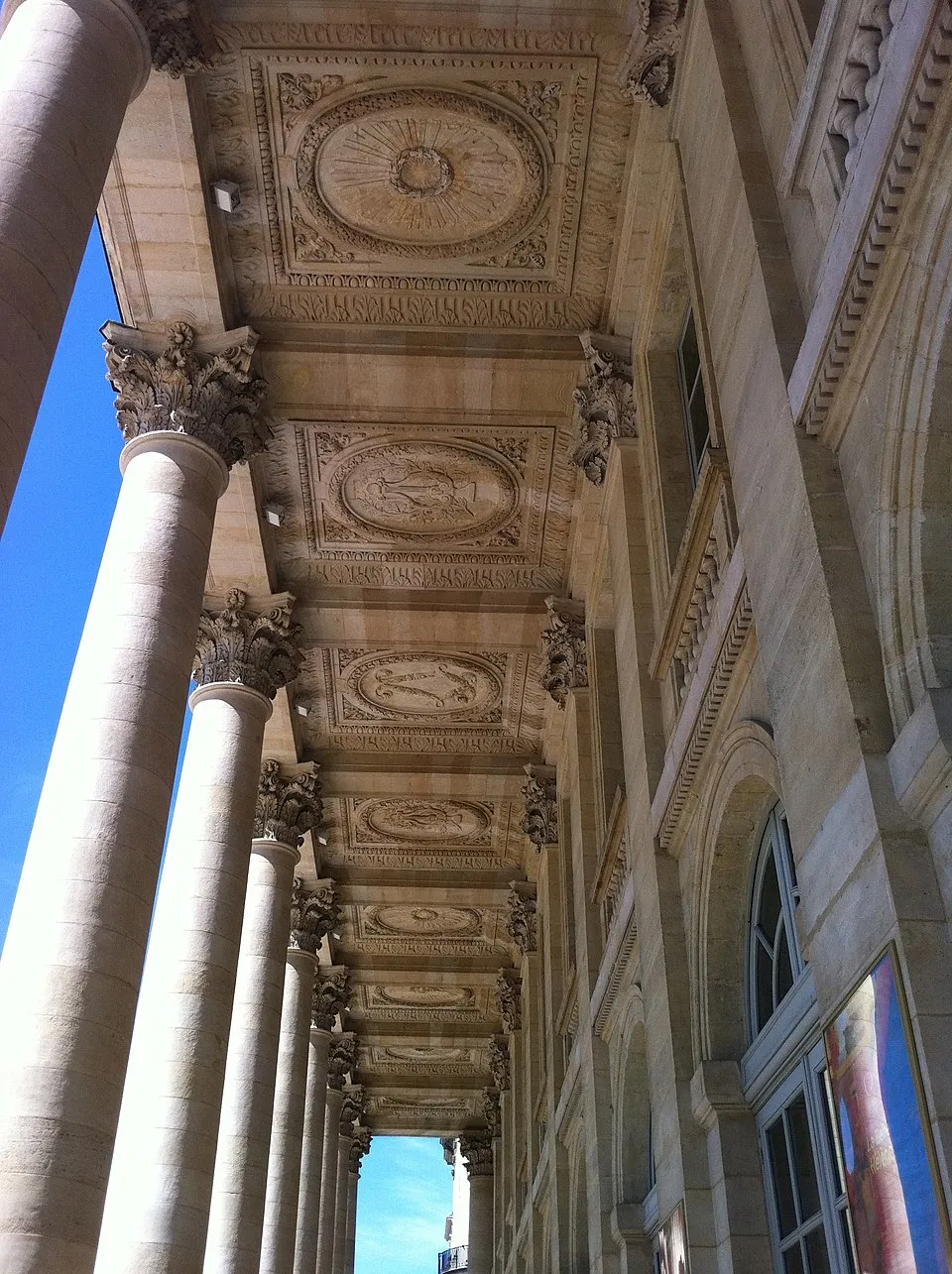
The façade of the Grand Théâtre reflects strict neoclassical principles.
The Columns
The twelve Corinthian columns dominating the front are not an ornamental exaggeration. They create vertical authority and rhythm. Their spacing is deliberate, reinforcing balance.
Unlike baroque excess seen elsewhere in Europe, this façade is restrained. Its power lies in proportion rather than ornament.
The Statues
Atop the colonnade stand statues representing the nine muses along with three goddesses. They symbolise the arts — music, poetry, dance — reinforcing the theatre’s purpose.
From below, they appear almost weightless, despite their scale.
The Staircase
Perhaps the most striking interior feature is the grand staircase. Its sweeping curves inspired later designs, including elements of the Paris Opera.
The staircase is theatrical before the performance begins. It transforms arrival into a ceremony.
Why the Location Matters
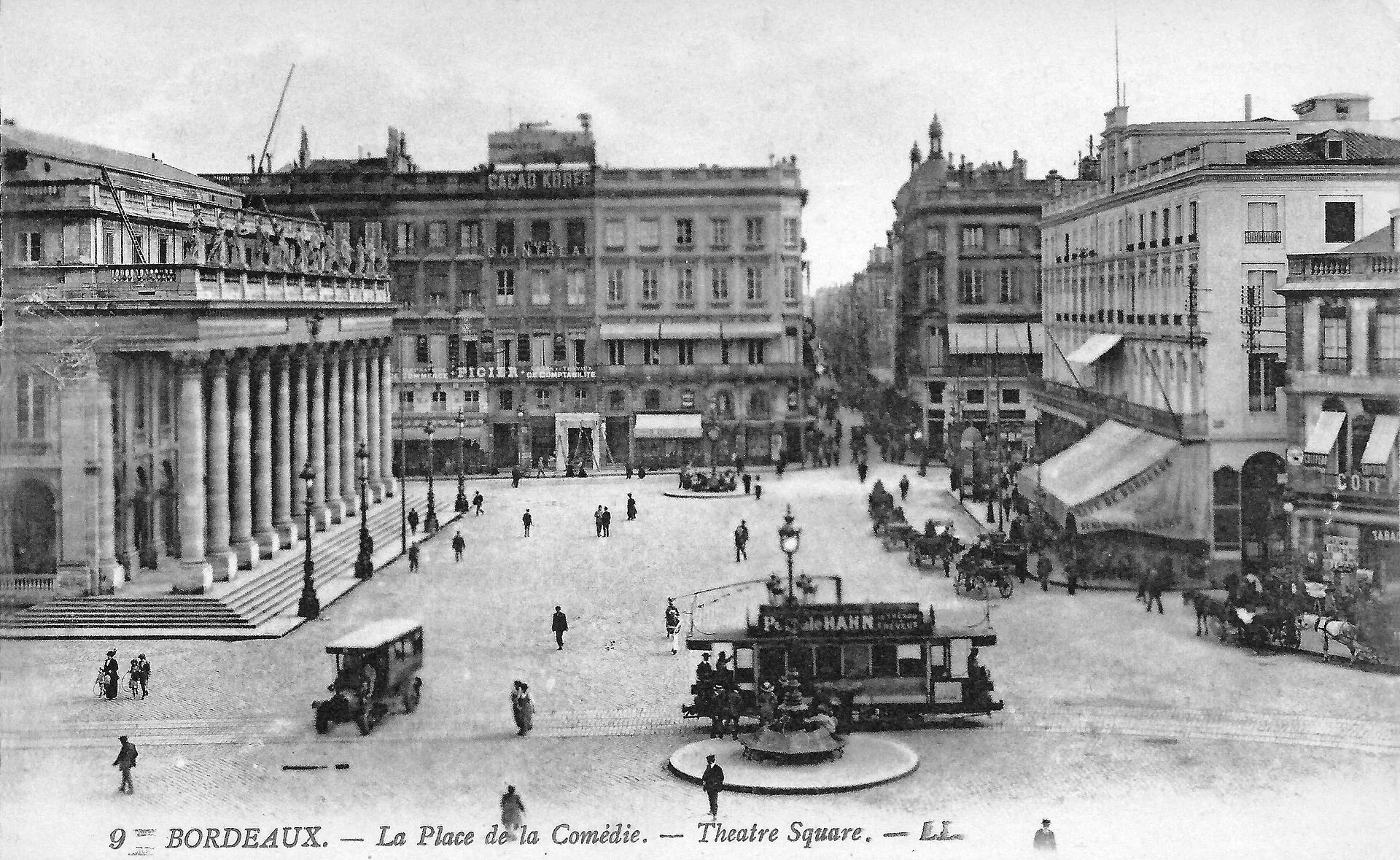
The theatre’s placement in Place de la Comédie was strategic.
It anchors one end of the Golden Triangle and acts as visual punctuation for the surrounding boulevards. From here, streets radiate outward in deliberate symmetry.
Stand at the centre of the square and look outward — the perspective lines reinforce order.
The theatre was not inserted randomly. It was positioned as a focal point within a redesigned urban plan.
Interior Acoustics and Design
Inside, the auditorium is horseshoe-shaped — a classic design for opera houses of the period. This shape enhances acoustics and visibility.
The ceiling painting and gilded balconies create intimacy despite scale. Unlike cavernous modern halls, the Grand Théâtre feels proportionate to human presence.
Even today, performances by the Opéra National de Bordeaux maintain that intimate atmosphere.
The building functions as it was intended.
Cultural Significance Beyond Performance
The Grand Théâtre represents more than entertainment.
It symbolises:
- Bordeaux’s Enlightenment-era confidence
- The city’s alignment with classical ideals
- The transition from a medieval trading port to a planned urban centre
When the French Revolution unfolded, the theatre remained — adapting to political shifts while preserving architectural integrity.
Its endurance speaks to its foundational role in the city’s identity.
The Theatre Today
Today, the Grand Théâtre continues to host:
- Opera productions
- Ballet performances
- Classical concerts
Visitors may attend performances or explore the interior on guided visits.
Even if you do not enter, standing before it in the evening light offers insight into Bordeaux’s aesthetic priorities.
The Grand Théâtre Through Revolution and Empire
When the Grand Théâtre opened in 1780, France was only nine years away from revolution. The building was born at the very edge of upheaval.
As the French Revolution unfolded, many aristocratic symbols were destroyed across the country. Yet the Grand Théâtre survived. It adapted to political change rather than resisting it.
During the revolutionary period, performances shifted in tone. Classical themes and royal patronage gave way to republican symbolism. The building’s architecture remained intact, but its function adjusted to the new political climate.
This ability to survive regime change reinforced its importance. It was not merely decorative — it had embedded itself into Bordeaux’s civic identity.
19th-Century Prestige and Refinement
Throughout the 19th century, the theatre became firmly established as one of France’s most elegant opera houses.
The city expanded, and the surrounding Golden Triangle developed further. Standing near Place des Quinconces and walking toward Place de la Comédie reveals how the theatre anchors the district visually.
Gas lighting was introduced, modernising performances. Interiors were refreshed carefully, preserving the original neoclassical integrity while accommodating evolving technical needs.
The theatre was never over-embellished. Its power remained in proportion and geometry.
20th-Century Restoration and Preservation
The 20th century brought inevitable wear. War, shifting artistic tastes, and modernisation pressures threatened many historic theatres across Europe.
Bordeaux chose preservation over replacement.
Restoration projects focused on maintaining original features — the grand staircase, ceiling artwork, and balcony structure. Unlike other cities that rebuilt opera houses in modern styles, Bordeaux retained its 18th-century character.
This continuity gives today’s visitor an unusually authentic experience. You are not stepping into a reconstruction. You are stepping into history that has been carefully maintained.
Architectural Influence Beyond Bordeaux
Victor Louis, the theatre’s architect, influenced theatre design beyond the city itself.
The sweeping staircase is often cited as inspiration for later grand opera houses, including elements of the Paris Opera.
The horseshoe auditorium became a standard reference point in theatre acoustics. Its scale strikes a balance between intimacy and grandeur — a balance many modern venues struggle to replicate.
The Grand Théâtre represents a moment when architecture served both civic pride and acoustic science.
Experiencing the Grand Théâtre Today
Visitors can attend performances or take guided tours inside the building.
Attending an evening opera changes your perception of the space. As lights dim and the orchestra begins, the gilded balconies glow softly, reinforcing the theatre’s purpose.
Even standing outside offers a powerful perspective. At dusk, when the façade illuminates, the columns cast elongated shadows across Place de la Comédie. The square feels composed rather than crowded.
Why It Still Defines Bordeaux
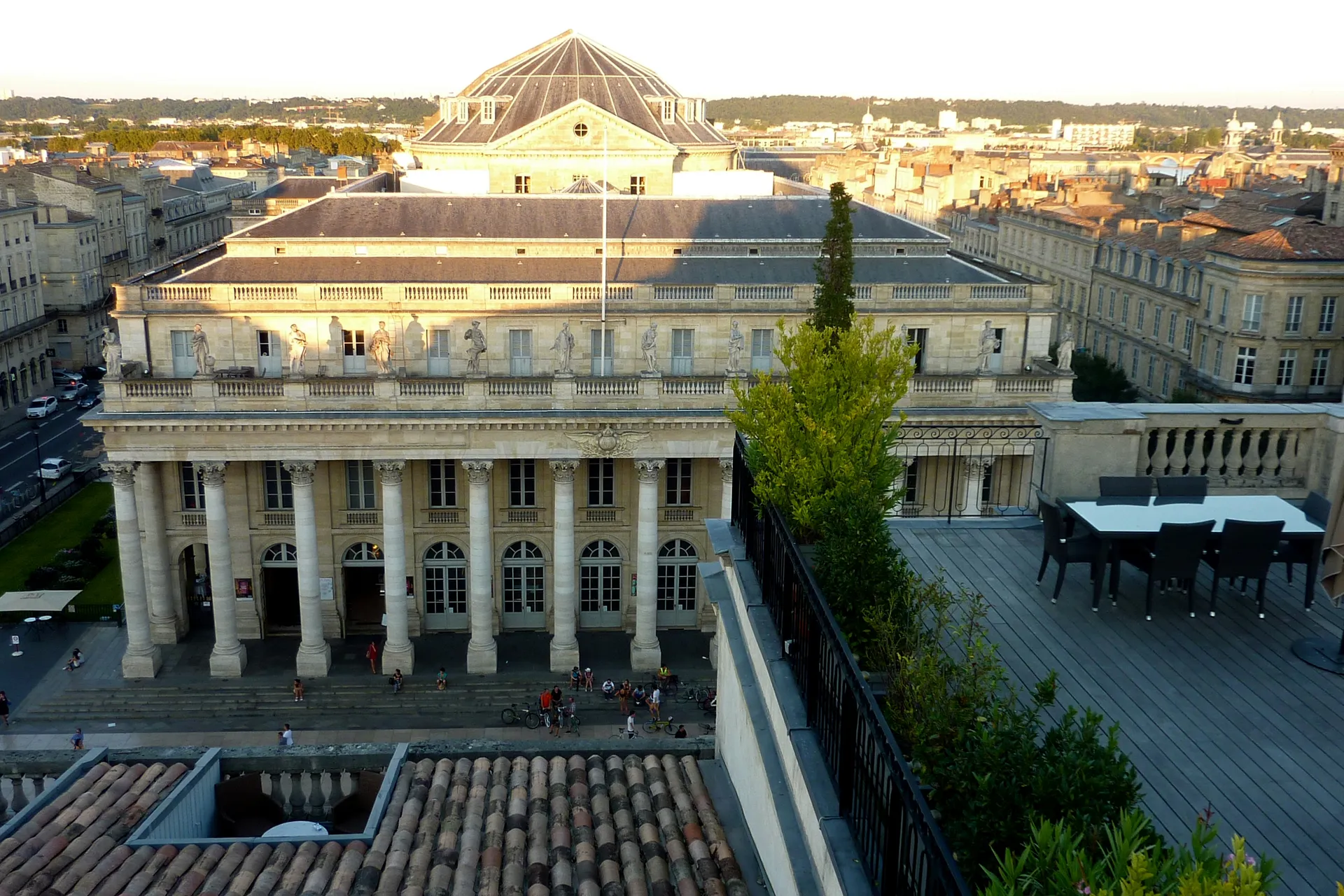
Many cities possess impressive theatres. Few integrate them so seamlessly into urban planning.
From the Grand Théâtre de Bordeaux, streets radiate outward in symmetry. The theatre is not hidden; it is the axis.
Its survival across centuries — revolution, empire, modernisation — reflects Bordeaux’s broader continuity. The city refines rather than replaces. It adapts without abandoning proportion.
Understanding this building changes how you see Bordeaux.
You begin to notice the consistent rhythm in façades, the repetition of classical balance, the confidence in restraint.
To truly grasp that cohesion, it helps to walk the historic centre with context. Seeing how the theatre connects visually to the surrounding boulevards and squares makes its role obvious. A thoughtful Bordeaux Free Walking Tour brings those alignments into focus, turning isolated admiration into architectural understanding.
A Closing Reflection
The Grand Théâtre is not simply a performance venue.
It is Bordeaux’s architectural statement of maturity — a declaration that commerce alone was not enough, that culture and proportion mattered equally.
Stand before it, and you see 18th-century ambition frozen in stone. Enter it, and you feel the continuity of that ambition.
Bordeaux can appear understated at first glance. But buildings like the Grand Théâtre reveal the city’s deeper confidence: measured, deliberate, enduring.
And once you recognise that rhythm, the entire historic centre begins to feel composed — as though the city itself were designed like an opera, balanced between structure and spectacle.