The Fontaine des Trois Grâces in Bordeaux: The Heart of Place de la Bourse
Few places capture the essence of Bordeaux as perfectly as the Fontaine des Trois Grâces. Set in the middle of Place de la Bourse, one of the city’s most elegant squares, it combines mythological symbolism, 19th-century artistry, and the daily rhythm of modern life. Stand before the fountain, with the Garonne River glistening nearby and the Miroir d’Eau reflecting its bronze figures, and you’ll understand why this is one of the most photographed spots in Bordeaux.
This fountain isn’t just decoration. It tells the story of Bordeaux itself: a city shaped by commerce, revolution, and renewal. To appreciate it, you need to look beyond the bronze and marble to the layers of history and meaning that surround it.
Place de la Bourse: Setting the Stage
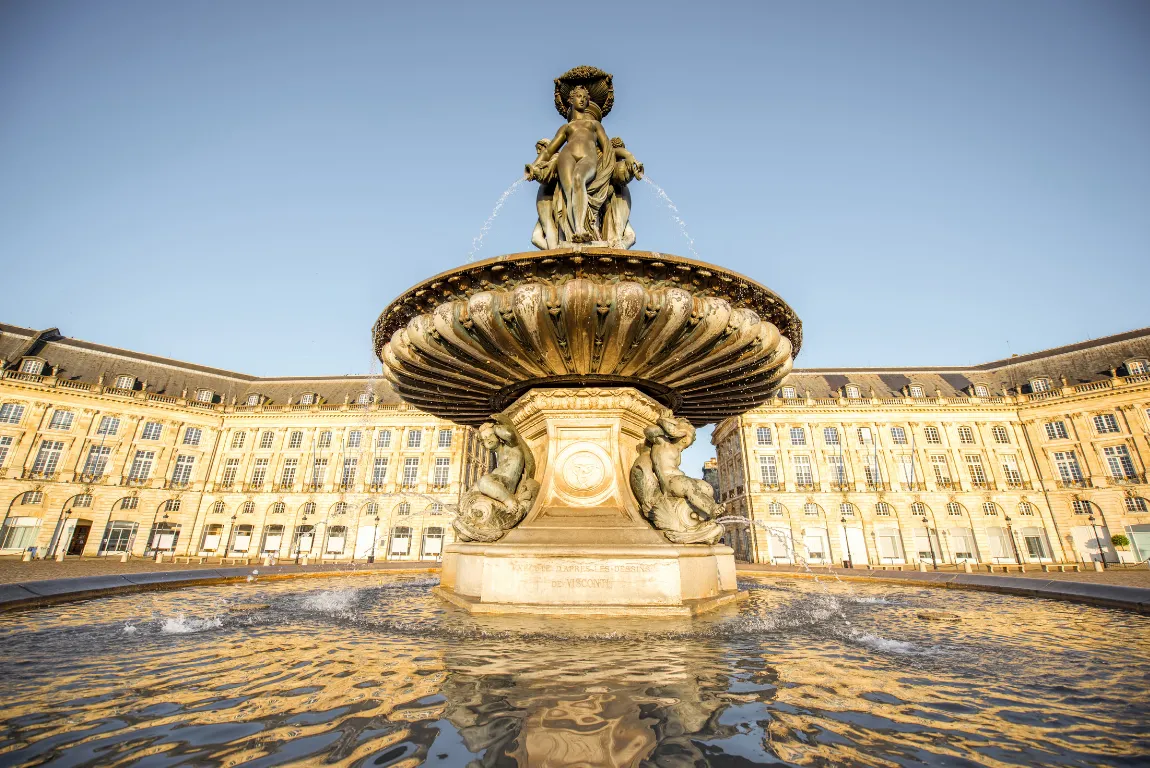
The story of the Fontaine des Trois Grâces begins with Place de la Bourse, once called Place Royale. Built in the 18th century, the square was designed by Ange-Jacques Gabriel, chief architect to King Louis XV. The idea was to create an architectural showcase on the riverfront that reflected Bordeaux’s prosperity as a wine port. The surrounding buildings—the Palais de la Bourse and the Hôtel des Fermes—framed the square with perfect symmetry, presenting a harmonious face to traders arriving by ship.
For decades, the centrepiece of the square was an equestrian statue of Louis XV. But history is rarely kind to royal monuments. The Revolution saw the statue destroyed, leaving the square oddly bare. A plain column took its place, but it never captured the imagination. Bordeaux wanted something both beautiful and meaningful.
A New Fountain for a Modern Bordeaux.
By the mid-19th century, the city council decided to commission a new fountain. They wanted a monument that reflected Bordeaux’s culture and values without the political overtones of kings and emperors. The solution was to turn to mythology.
The **Three Graces—Aglaé, Euphrosyne, and Thalie—**had been celebrated in art for centuries. As daughters of Zeus, they represented beauty, joy, and abundance. They were companions of Aphrodite and muses of creativity and harmony. Their symbolism was universal, timeless, and far removed from the turbulence of politics.
The fountain was designed in the 1860s by the architect Louis Visconti (better known for designing Napoleon’s tomb at Les Invalides). After his death, his son Léon continued the project, and sculptor Charles Gumery created the figures themselves. The bronzes were cast by the Thiébaut brothers, master founders of the time.
In 1869, the Fontaine des Trois Grâces was unveiled. At first, it caused a stir. Some Bordelais were scandalised by the nudity of the statues, and local priests refused to bless the fountain. But time worked in its favour. The city embraced the Graces as their own, and today they are among Bordeaux’s most loved figures.
Reading the Fountain: Symbolism and Detail.
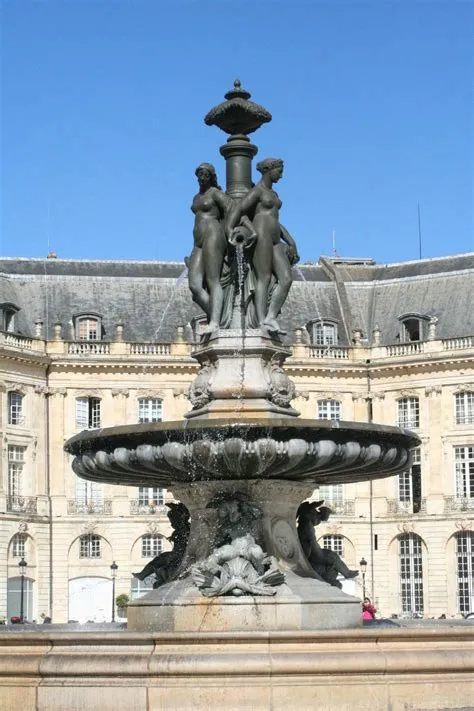
Stand close to the fountain and you’ll notice how carefully it was composed. The three goddesses stand in a circle, arms gently entwined, turning in different directions. Each figure offers a different quality:
- Aglaé, representing beauty, faces the river.
- Euphrosyne, symbolising joy, gazes outward, her hair flowing.
- Thalie, embodying abundance, looks towards the city.
Around the base, cherubs ride dolphins, water spouting from their mouths into the basin below. The dolphins remind us of Bordeaux’s maritime trade, while the flowing water symbolises the lifeblood of the city and the renewal that comes with time.
The materials also tell a story. Bronze for permanence, marble for dignity, and cast iron for strength. The mix reflects Bordeaux’s own identity: grounded in tradition yet built on innovation and exchange.
A Place for People, Not Just Art.
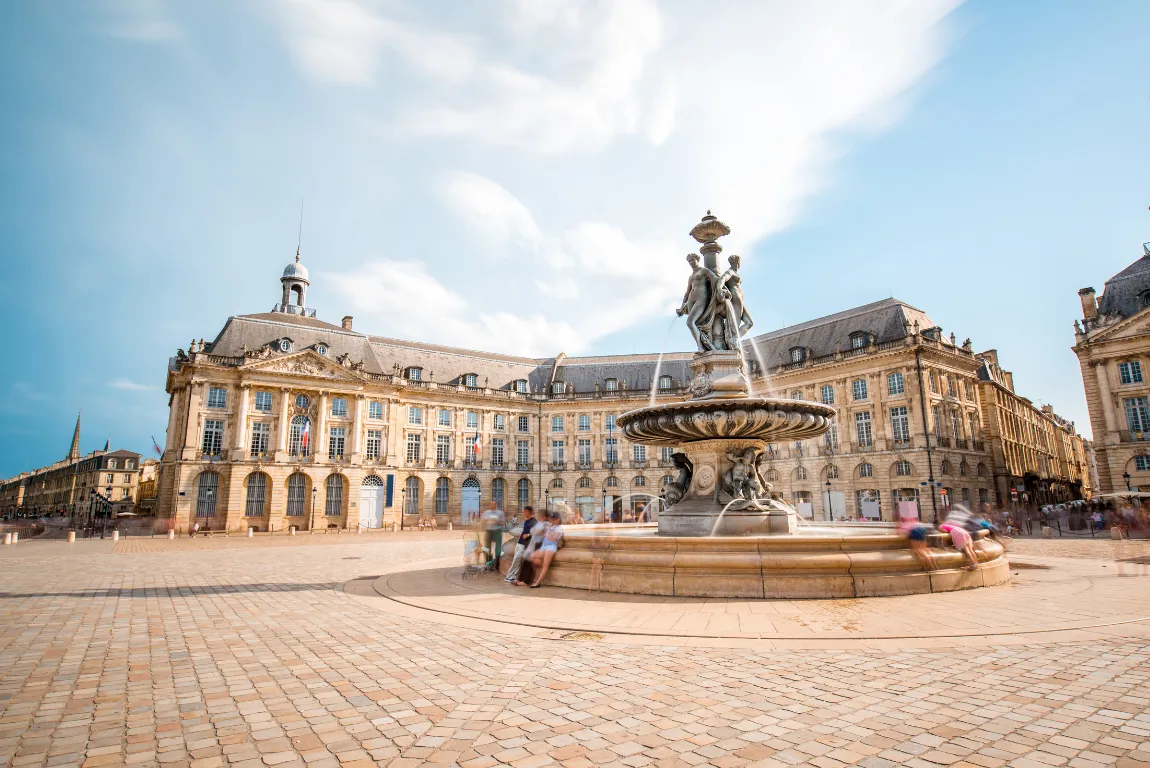
What makes the Fontaine des Trois Grâces so beloved is that it was created not to glorify a ruler but to enrich public space. It belongs to everyone. Over time it has become the natural meeting point of the city. Locals arrange to meet “at the Graces” before heading off for an evening by the river. Tourists gather to take photos with the fountain in the background. Children climb the stone steps while parents sit on the edge chatting.
Unlike some monuments that feel frozen in history, the Graces live with the city. They are part of its daily rhythm.
The Fountain and the Miroir d’Eau
Across the tramlines from the fountain lies the Miroir d’Eau, the world’s largest reflecting pool. This modern installation, completed in 2006, has transformed Place de la Bourse into one of Bordeaux’s most iconic sights.
On still days, the fountain reflects perfectly in the shallow water, creating a double image of the bronze figures and the classical façades behind them. When the mist rises from the Miroir d’Eau, the Graces appear to float in a dreamlike haze. At sunset, the reflection doubles the golden glow of the square, producing a scene that feels almost otherworldly.
Few monuments in Europe can claim such a perfect dialogue between classical art and contemporary design.
Restoration and Renewal
The fountain has not always looked as fresh as it does today. Like all outdoor monuments, it suffered from time and pollution. It was restored several times in the 19th and 20th centuries. During the construction of Bordeaux’s tramway, the fountain was even dismantled and carefully stored, before being returned to its rightful place in 2006. Its re-installation was met with celebration, as many Bordelais felt the square was incomplete without the Graces watching over it.
Like the nearby Passerelle Eiffel, which was also preserved as part of Bordeaux’s architectural heritage, the fountain’s restoration shows how the city values its historic landmarks while continuing to modernise.
A Fountain with a Modern Role
In recent years, the fountain has taken on symbolic roles that keep it relevant. Since 2009, each October the statues wear pink ribbons and the water turns pink to mark Breast Cancer Awareness Month. This small gesture has become one of the most striking seasonal sights in Bordeaux. It’s a reminder that monuments, though rooted in the past, can carry messages for the present.
The Graces also feature in countless postcards, travel blogs, and social media posts. They are ambassadors for Bordeaux’s image as a city of elegance, history, and joy.
Experiencing the Fountain as a Traveller
If you’re visiting Bordeaux, the fountain is impossible to miss. But to truly appreciate it, linger for a while.
- Morning: Arrive early, when the square is quiet and the Miroir d’Eau is still. The reflections are magical, and you’ll have the fountain almost to yourself.
- Afternoon: Watch the bustle of city life unfold around the fountain. Trams glide past, tour groups gather, and locals stop to rest.
- Sunset: The best time for photography, when the golden light bathes the bronze figures and the river shimmers beyond.
- Evening: With the fountain lit up and the square alive with people, the Graces take on a new life, glowing softly against the night sky.
For those who want context, joining a guided experience is invaluable. On a Bordeaux Free Walking Tour, you don’t just see the fountain—you hear the stories behind it. You learn about the priest who refused to bless it, the symbolism of the dolphins, and how the square has shifted through revolutions, restorations, and modernisation. It turns a beautiful monument into a living chapter of Bordeaux’s story.
Why the Fontaine des Trois Grâces Matters.
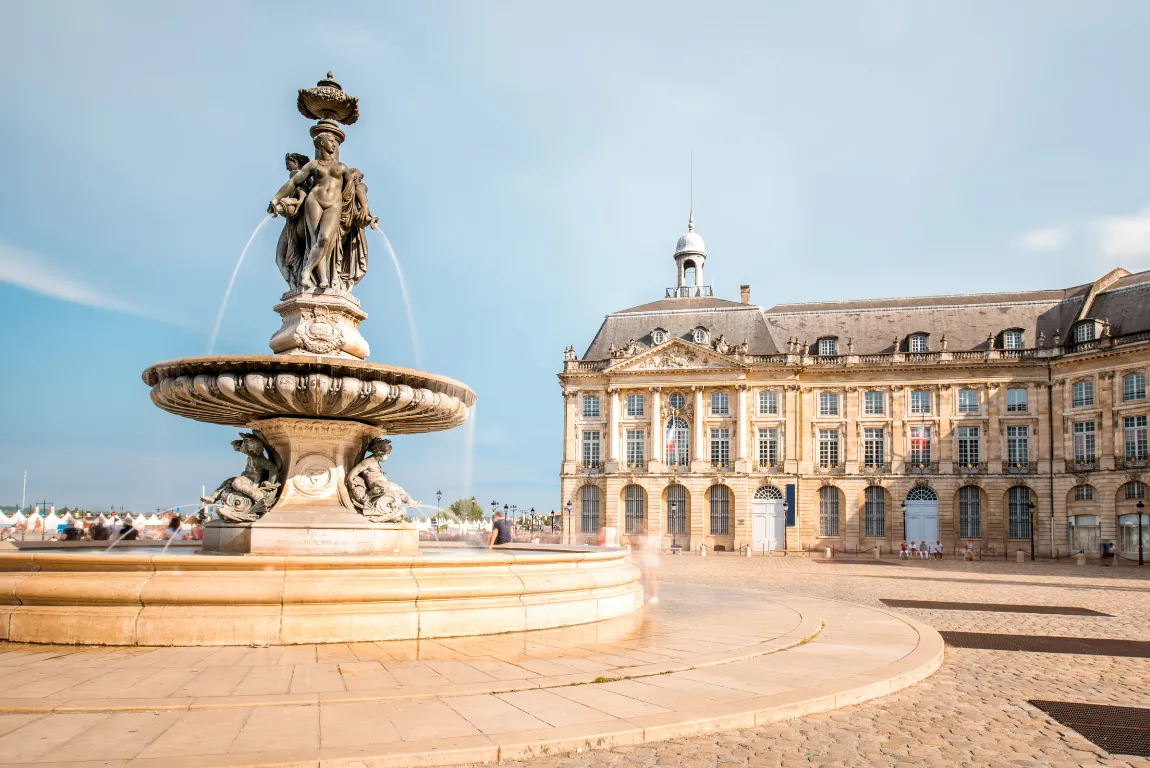
Every city has monuments that define it. In Paris, it’s the Eiffel Tower. In Rome, the Trevi Fountain. In Bordeaux, it’s arguably the Fontaine des Trois Grâces.
It matters because it embodies what Bordeaux is about. It reflects the city’s history as a wine port and a centre of trade. It celebrates universal values rather than political power. It enriches public space, bringing art into daily life. And it adapts, whether reflecting in the modern Miroir d’Eau or wearing pink ribbons for awareness campaigns.
Most of all, it matters because it feels alive. The Graces are not distant or untouchable. They are part of the everyday—watched, photographed, leaned against, and lived with.
Things to Know Before You Go
- Location: Place de la Bourse, Bordeaux city centre, directly opposite the Garonne River.
- Nearest tram stop: Line C, Place de la Bourse.
- Accessibility: The square is pedestrian-friendly and flat, making it easy for all visitors.
- When to visit: Early morning or sunset for the most atmospheric views.
- What else to see nearby: The Customs Museum, the Garonne quayside, and the Miroir d’Eau.
Final Reflections
The Fontaine des Trois Grâces is more than just a fountain in a square. It’s a symbol of Bordeaux itself—elegant, layered with history, yet still very much part of modern life. Whether you come to admire its artistry, to take photos reflected in the Miroir d’Eau, or simply to sit nearby and watch the world go by, the experience lingers long after you leave.
Stand before the Graces, and you’ll see why they have become part of Bordeaux’s heartbeat. They represent beauty, joy, and abundance—not just as mythological ideals, but as qualities the city itself continues to embody.