Bordeaux’s “Water Mirror” Science: How the Miroir d’Eau Actually Works
The Miroir d’Eau is one of the most photographed sites in Bordeaux, yet very few visitors understand the engineering that makes this extraordinary surface behave the way it does. People walk across it, photograph its slow mist, admire its reflections, and feel the soft water rising around their feet, but the mechanics behind it are rarely explained. The Water Mirror seems almost magical — a thin sheet of water mirroring the façade of Place de la Bourse, then disappearing, then reappearing in a cloud of mist.
But the Miroir d’Eau is not magic. It is a carefully engineered marvel of timing cycles, water hydraulics, ground heating, underground basins, atmospheric control, and surface tension design. Understanding how it works adds depth to the experience, turning what most visitors see as a playful fountain into one of the most sophisticated urban water installations in Europe.
This guide explores the science behind the Miroir d’Eau, revealing how the system manages reflection, mist, drainage, safety, and environmental sustainability — and why it has become a symbol of modern Bordeaux.
The Vision Behind the Miroir d’Eau
The Miroir d’Eau was conceived as part of Bordeaux’s early-2000s urban redevelopment, turning former car-dominated quays into expansive public spaces. Architects and landscape engineers imagined something that would complement the grandeur of Place de la Bourse, bringing movement, reflection and interaction to the riverfront.
To better understand the 18th-century architecture reflected in the water, you can explore our detailed guide to Place de la Bourse in Bordeaux, which explains the history and design of the façade that makes the mirror effect so iconic.
Their goal was simple:
Create a thin sheet of water that perfectly reflects the 18th-century façade and sky — and then make it vanish.
But achieving that thin, perfectly still reflective layer required years of engineering refinement.
Understanding the Surface: Porphyry Stone & Micro-Level Precision
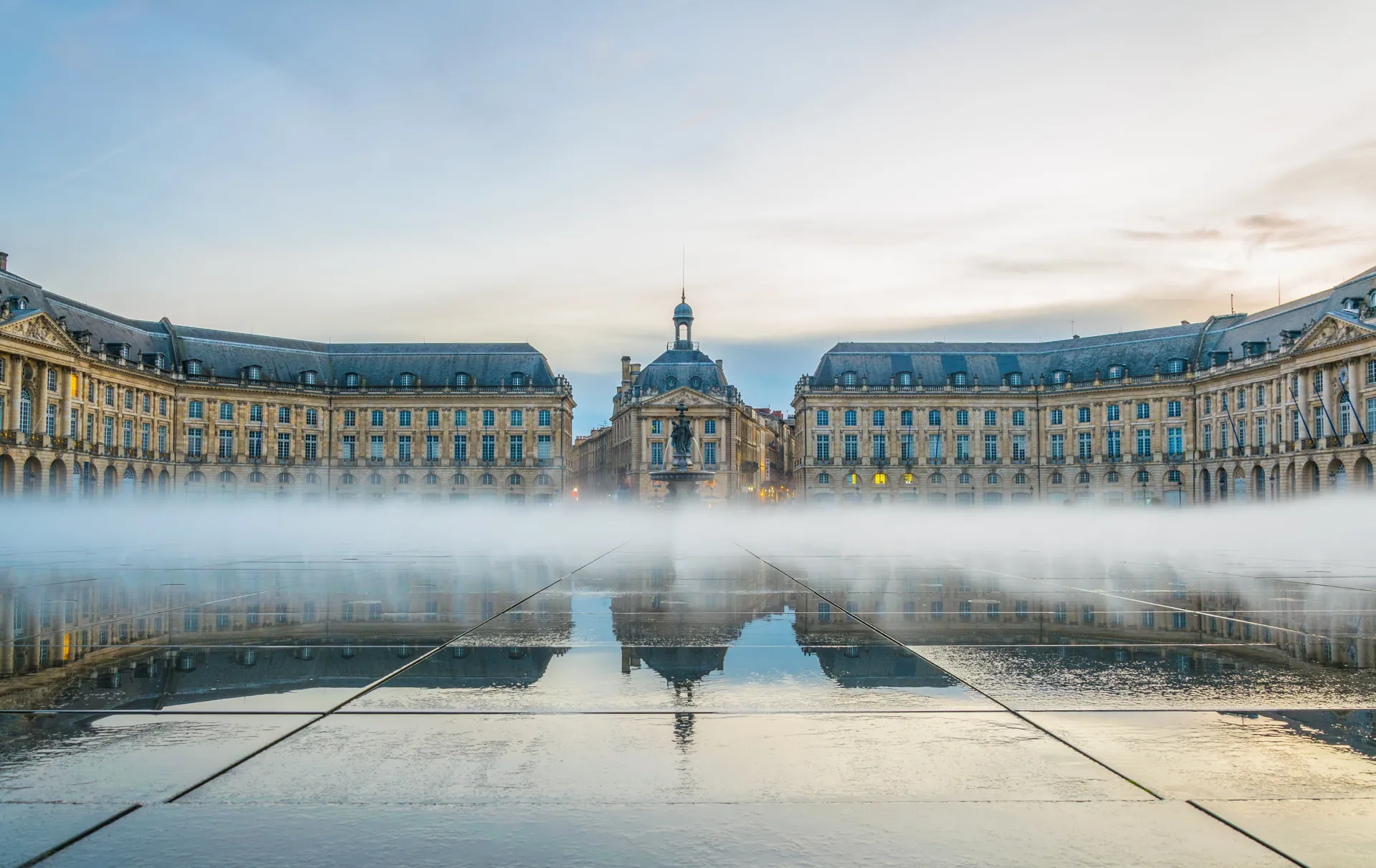
The ground beneath the Miroir d’Eau is made of porphyry stone tiles, chosen for their:
- durability
- subtle texture
- ability to remain safe when wet
- capacity to maintain minimal height variation across a large surface
For a mirror effect to work, the surface must be almost perfectly level.
Even a 2-millimetre slope would destroy the reflection.
To achieve this:
- Every stone block was cut to extremely precise measurements
- Installation crews levelled each tile individually
- Underground supports were positioned to keep the slab surface stable
- Expansion joints allow the surface to withstand temperature changes
The result is a surface flat enough for water to spread in an uninterrupted sheet.
The Water Layer: Shallow, Constantly Renewed, and Micro-Engineered
When active, the water on the Miroir d’Eau reaches a depth of only 2 centimetres.
Why 2 cm?
Because this is:
- enough to create a perfect reflection
- shallow enough for safety
- easy to drain quickly
- low-consumption compared with deeper fountains
- ideal for creating surface tension
The entire design depends on this exact balance.
The Hidden System: Underground Basins & Pumping Rooms
Below the surface lies a network of:
- water storage basins
- filtration units
- high-pressure pumps
- mist generators
- drainage channels
- heating systems
- programmable valves
Each part plays a specific role in sustaining the timed cycles.
Most of the machinery is hidden underground along the Garonne side.
Visitors see only water and stone, but the system beneath is in constant motion.
The Three-Phase Cycle: Reflection, Disappearance & Mist
The Miroir d’Eau operates in a repeating cycle lasting roughly 15–20 minutes.
This cycle allows the installation to remain dynamic while preserving the quality of reflections.
Here is how the system works step by step:
1. The “Mirror Phase” — still water for perfect reflection
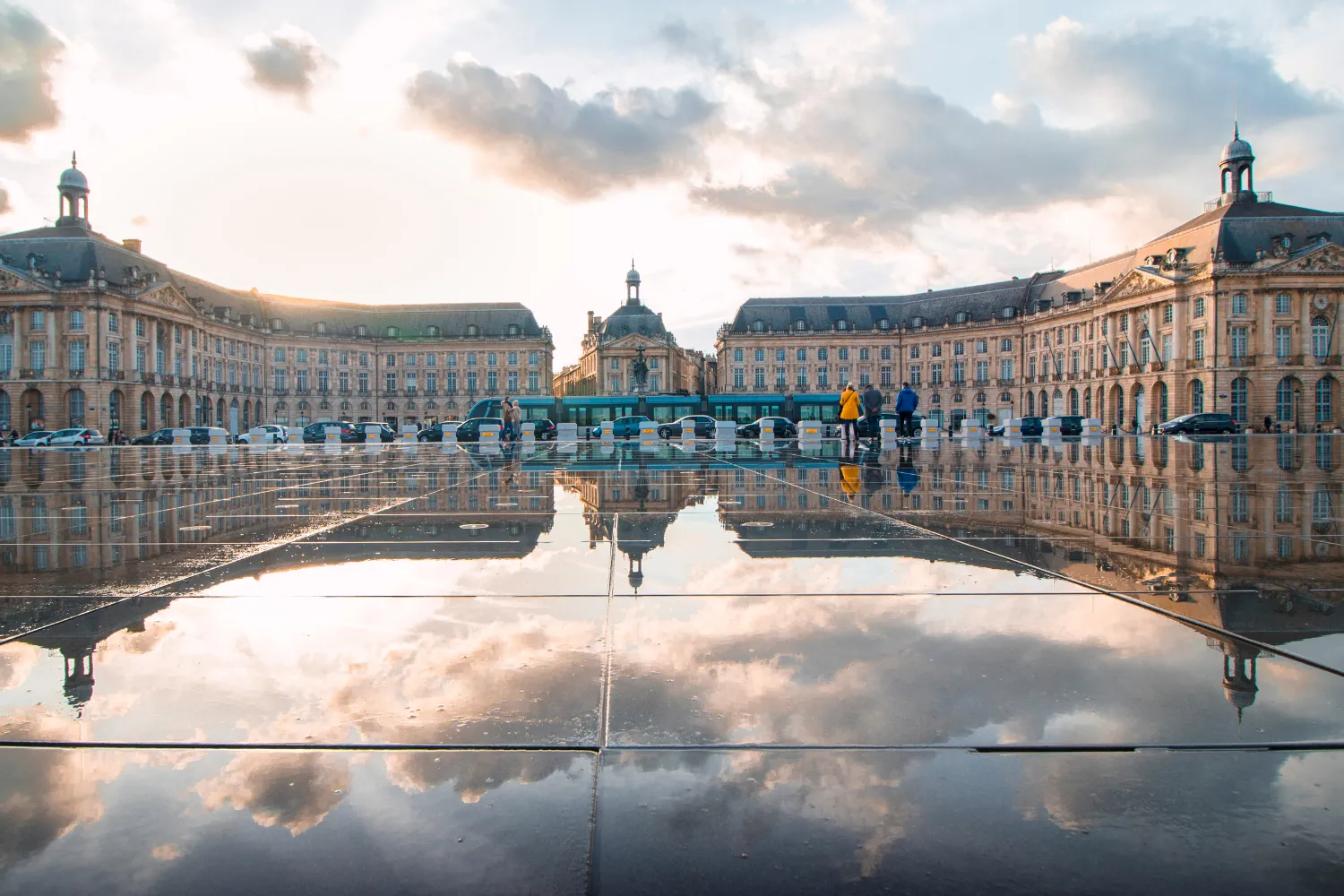
The pumps send water gently onto the stone surface through narrow slits along the edges.
The goal is to create a perfectly even layer with minimal disturbance.
Key elements:
- ultra-low pressure to avoid ripples
- constant micro-adjustment based on wind conditions
- sensors that maintain uniform depth
During this phase, photographs capture the iconic reflection of Place de la Bourse.
The slightest breeze affects the pattern, so engineers accounted for wind by placing dispersal channels and pressure regulators.
2. The “Drain Phase” — water disappears almost instantly
Once the reflection phase is complete, drainage valves open beneath the surface.
The entire 3,450-square-metre sheet empties through:
- hidden gutters
- micro-perforated stone joints
The water returns to the underground basin for filtration and re-use.
This rapid transformation from full reflection to bare stone creates surprise and movement.
3. The “Mist Phase” — a cloud rising from the ground
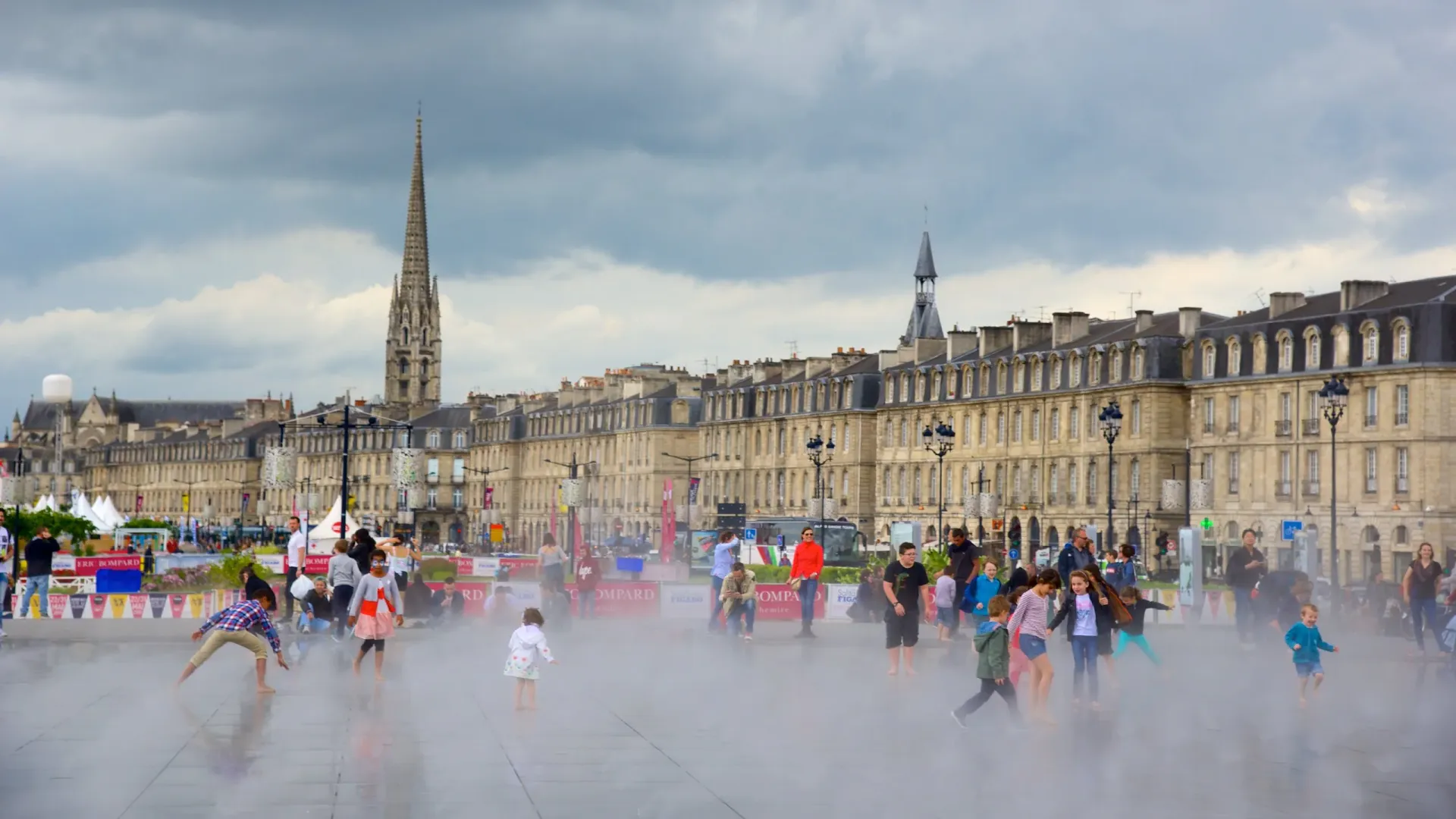
After the surface has dried just enough, hundreds of mist nozzles activate.
The mist is not random; it is engineered.
It is produced by:
- high-pressure pumps
- atomising nozzles
- air entrainment tubes
This produces a cooling, cloudlike effect that rolls across the surface.
The mist has three aims:
- create a dreamlike visual
- offer natural cooling in summer
- mask the transition before the mirror phase restarts
Children play in it, adults photograph it, and on hot days, it feels almost essential.
Water Treatment & Sustainability
The Miroir d’Eau reuses water through a closed-loop system.
The water is:
- filtered
- oxygenated
- UV-treated
- circulated
- monitored for clarity
Chemical treatment is minimal; the goal is to keep the water clean while reducing environmental impact.
Sensors constantly check:
- temperature
- flow
- pressure
- water purity
The system adjusts itself depending on the season and the weather.
How Temperature Affects the Miroir d’Eau
Winter presents a challenge:
Water just 2 cm deep freezes easily.
To prevent icing and slipping dangers:
- ground-level heating coils warm the stone surface
- Insulation layers maintain thermal balance
- The system automatically shuts down when temperatures drop too low
This is why the Miroir d’Eau operates primarily in warmer months and closes periodically during winter.
Why the Reflections Look So Clear
Visitors often wonder why reflections on the Miroir d’Eau appear sharper than reflections in natural water.
The reasons:
- shallow depth limits distortion
- absence of waves
- perfectly controlled water flow
- high-quality stone surface
- alignment with architectural lines
The geometry between the surface and the façade of Place de la Bourse was carefully calculated during design.
The Garonne Influence: Wind, Light & Humidity
The Garonne River sits directly beside the Miroir d’Eau.
Its presence affects the installation in profound ways:
Wind
Wind disrupts reflections, so sensors adjust water pressure depending on direction and speed.
Light
The limestone façades glow at sunrise and sunset, giving the reflections their golden quality.
Humidity
High humidity enhances the mist effect, making it linger longer.
Temperature
Heat radiating from the quay affects evaporation cycles.
The Miroir d’Eau is not an isolated fountain — it is part of the river ecosystem.
When the Miroir d’Eau is Most Beautiful
While it is beautiful at all hours, the Water Mirror has certain moments where its magic is strongest.
Early Morning
With fewer people, the reflection is almost perfect.
Sunset
The limestone façades glow gold, and the water intensifies the colour.
After Rain
Humidity helps mist sit lower and longer.
Night
The lights of Place de la Bourse shimmer across the water.
These natural conditions show how engineering meets atmosphere.
Why Children Love the Miroir d’Eau
The installation was designed with interaction in mind:
- Shallow water is safe
- mist feels playful
- The cycles create anticipation
- The open space invites movement
The city wanted an artwork that also served as a communal playground — an inclusive public space rather than a sculpture behind barriers.
How the Miroir d’Eau Transformed Bordeaux’s Quays
Before the redevelopment, this area was dominated by traffic and warehouses.
The Water Mirror became a symbol of the city’s rebirth.
It encouraged:
- walking
- cycling
- outdoor relaxation
- photography
- social gatherings
Travellers today often begin exploring Bordeaux along the quays — many start with a guided walk with Bordeaux Free Walking Tours, which introduces the history of Place de la Bourse and the design story of the quays:
https://bordeauxfreewalkingtours.com/
Nearby Places That Contribute to the Miroir’s Atmosphere
Place de la Bourse
Place de la Bourse
Its symmetrical architecture provides the iconic reflection.
Garonne Riverbank
Quai de la Douane
The riverside setting offers light, wind, and openness.
Chartrons District
A nearby neighbourhood whose façades and elegant streets give the area its refined character.
Saint-Pierre Quarter
Its atmospheric medieval lanes sit just behind the mirror.
FAQ Visitors Often Ask (With Scientific Answers)
Why does the water seem to appear all at once?
Because the system releases water simultaneously through hundreds of edge slits with synchronised valves.
Why does the mist look like fog?
The mist is made using high-pressure nozzles that atomise water into droplets smaller than 10 microns — roughly the size of natural fog particles.
How often does the cycle repeat?
Around every 15–20 minutes, depending on wind and temperature conditions.
Is the water clean?
Yes — it circulates through filtration, UV treatment, and oxygenation systems.
Why does it shut down in winter?
Risk of freezing and damage to the stone surface and hydraulic components.
A Final Reflection on the Miroir d’Eau
The Miroir d’Eau looks simple — a thin sheet of water, a cloud of mist, a moment of reflection. Yet beneath the surface lies one of Bordeaux’s most remarkable achievements in urban engineering. The installation blends architecture, hydraulics, atmosphere, and landscape design, reflecting not only the beauty of Place de la Bourse but the spirit of a modern city that values creativity, playfulness, and connection.
Understanding the science behind the mirror transforms the experience.
You see how carefully everything works: the timing, the water film, the mist, the light, the evaporation, the drainage. You realise that this quiet spectacle is the result of extraordinary precision.
To appreciate how the Water Mirror fits into Bordeaux’s architectural story, many travellers choose to explore the city with Bordeaux Free Walking Tours:
https://bordeauxfreewalkingtours.com/
The Water Mirror is not only a reflection of the building — it is a reflection of Bordeaux itself, a city where engineering and beauty meet.