The Hôtel de Ragueneau: A Historic Gem in Bordeaux
The Hôtel de Ragueneau, one of Bordeaux’s most stunning 17th-century mansions, stands as a testament to the city's rich architectural heritage. Until 2015, this elegant residence served as the home of the Bordeaux Municipal Archives. The inscription engraved on the front of the building today reads "Archives Municipales", reflecting its historical role as a centre of knowledge. A stop on your Bordeaux walking tour will surely highlight this remarkable piece of Bordeaux history. Explore the city’s architectural landmarks in context on a Bordeaux Walking Tour and understand how historic residences shaped the Bordeaux city centre.
A Mansion of Prestige
In 1642, Jeanne de Seurin, the widow of Pierre de Ragueneau, a parliamentary advisor, commissioned Pierre Léglise to design this grand residence on the site of two older houses. The mansion was built in the traditional courtyard-and-garden style, with a boundary wall topped with battlements—a clear display of the family's prominence. By 1643, construction was complete.

During your Bordeaux history tour, you'll learn how the mansion's architectural legacy is intertwined with the city's past, including its transformation into a site for municipal archives and scholarly societies. This mansion is not only a residence but a living symbol of Bordeaux's rich history, similar to other historic sites featured in Best Sites In Bordeaux.
Changing Ownership Through Centuries
After remaining in the Ragueneau family for several decades, the mansion was sold in 1700 to Joseph de Gillet for €850,000 (today's value). In 1770, Baron Léonard de Paty du Rayet acquired the property for €1,189,370 (today's value). However, his life met a tragic end, as he was guillotined during the French Revolution—an event that would later be remembered on any Bordeaux walking tour as part of the city's tumultuous history.
Following his execution, his daughters sold the property, and in 1806, it was purchased by the merchant Simon Monsarrat for €1,295,000 (today's value). Eventually, his sister, Marquise Monsarrat, inherited the building in 1828 and, upon her death in 1843, left it to Pierre-Jean Monsarrat.
The Hôtel de l’Octroi and Municipal Archives
The City of Bordeaux rented the mansion from 1846, officially purchasing it in 1860 for €1,697,320 (today's value). It housed the Octroi services until 1928, when the taxation system was abolished. The property then began a new chapter as the Municipal Archives, which you can still explore on a Bordeaux history tour. The broader civic development of Bordeaux is also explored in Bordeaux City Tour: Famous Figures from Bordeaux, which connects personalities and places across the historic centre.
Architectural Legacy and Hidden Treasures
Built in a Louis XIII style with elements of both Renaissance and Classical architecture, the mansion features three levels, five bays, and plastered rubble walls.
One of its most notable features is the entrance gallery, added by Marquis de Lacaze, with a wrought-iron balustrade bearing his intertwined initials in the central medallion.
During the 1939 renovations, architect Jacques D’Welles embedded elements from demolished historic buildings into the interior courtyard wall, including a Carrara marble medallion and ironwork salvaged from other Bordeaux landmarks.
A Living Symbol of Bordeaux’s Heritage
One of the most unique living features of the Hôtel de Ragueneau is its Chinese wisteria, planted around 1863 (or possibly 1901, according to some sources). Recognized as a Remarkable Tree of France in 2012, cuttings from this century-old wisteria have since been transplanted to the new archives facility in the Bastide district.
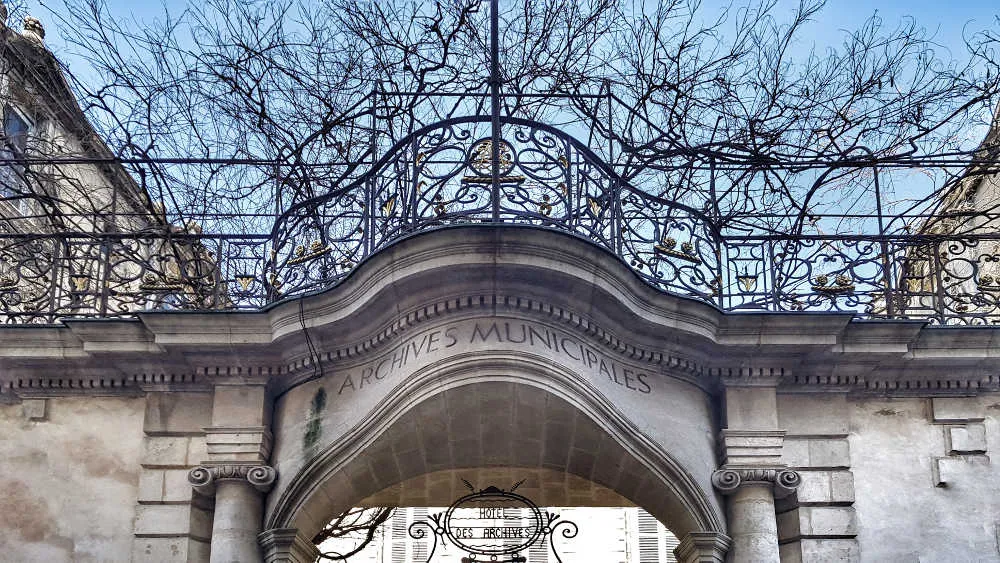
This iconic wisteria, along with the building's architectural features, makes the Hôtel de Ragueneau a must-see on any Bordeaux walking tour.
A Future for the Hôtel de Ragueneau
After the archives' relocation in 2015, the City of Bordeaux, still the mansion’s owner, explored potential new uses for the building. As one of the last remaining 17th-century private mansions in Bordeaux, the Hôtel de Ragueneau remains an invaluable piece of the city's architectural and historical legacy.
Final Thoughts
From a prestigious family residence to a tax office, a centre of knowledge, and later a municipal archive, the Hôtel de Ragueneau has evolved over centuries while preserving its timeless elegance. Whether admired for its Renaissance details, rich history, or even its famous wisteria, it remains one of Bordeaux’s most cherished historic sites. Consider visiting it on a Bordeaux history tour to experience the grandeur firsthand. Plan your visit and explore Bordeaux’s historic centre with a Bordeaux Walking Tour.